Skip to content
Voroven

ENERGY OPTIMISATION

Optimisation that understands how buildings operate

Voroven is developing a flexible, context-aware optimisation layer that coordinates heating, cooling and other flexible electrical loads around energy prices, forecasts and operational requirements.

The technology is designed to work across different kinds of equipment and building environments, connecting to compatible existing controls and adapting operation as conditions change.

THE OPTIMISATION APPROACH

From building context to verified operation

Four connected stages bring information, planning, equipment control and performance feedback into one system.

  1. Understand

    Combine energy prices, consumption, weather, equipment state and operating requirements.

    Interpret everyday requests, activities, schedules and exceptions alongside occupancy, available solar generation and the limits each piece of equipment must respect.

  2. Optimise

    Plan when and how equipment operates, accounting for forecasts and constraints.

    Compare operating plans against predicted energy costs and building needs. Update the plan as conditions change, within agreed comfort and equipment limits.

  3. Control

    Coordinate compatible equipment through controlled integrations with safety limits and overrides.

    Translate plans into equipment actions, with explicit control handoffs, checks on device state and a way for people to override automated operation.

  4. Verify and improve

    Compare planned and actual operation, then use the evidence to guide improvements.

    Record energy use, costs, comfort, failures and overrides. Propose and test changes to strategies or software, with human review before adoption.

Observe results → propose changes → test → human review → adopt.

RESIDENTIAL PRODUCT EVIDENCE

Predictive planning and measured operation

These prototype outputs show a modelled operating plan and a completed residential monitoring run. Together they help identify differences between predictions and actual equipment behaviour. Neither establishes measured savings against a thermostat baseline.

01 / Illustrative simulation

A tariff-aware operating plan

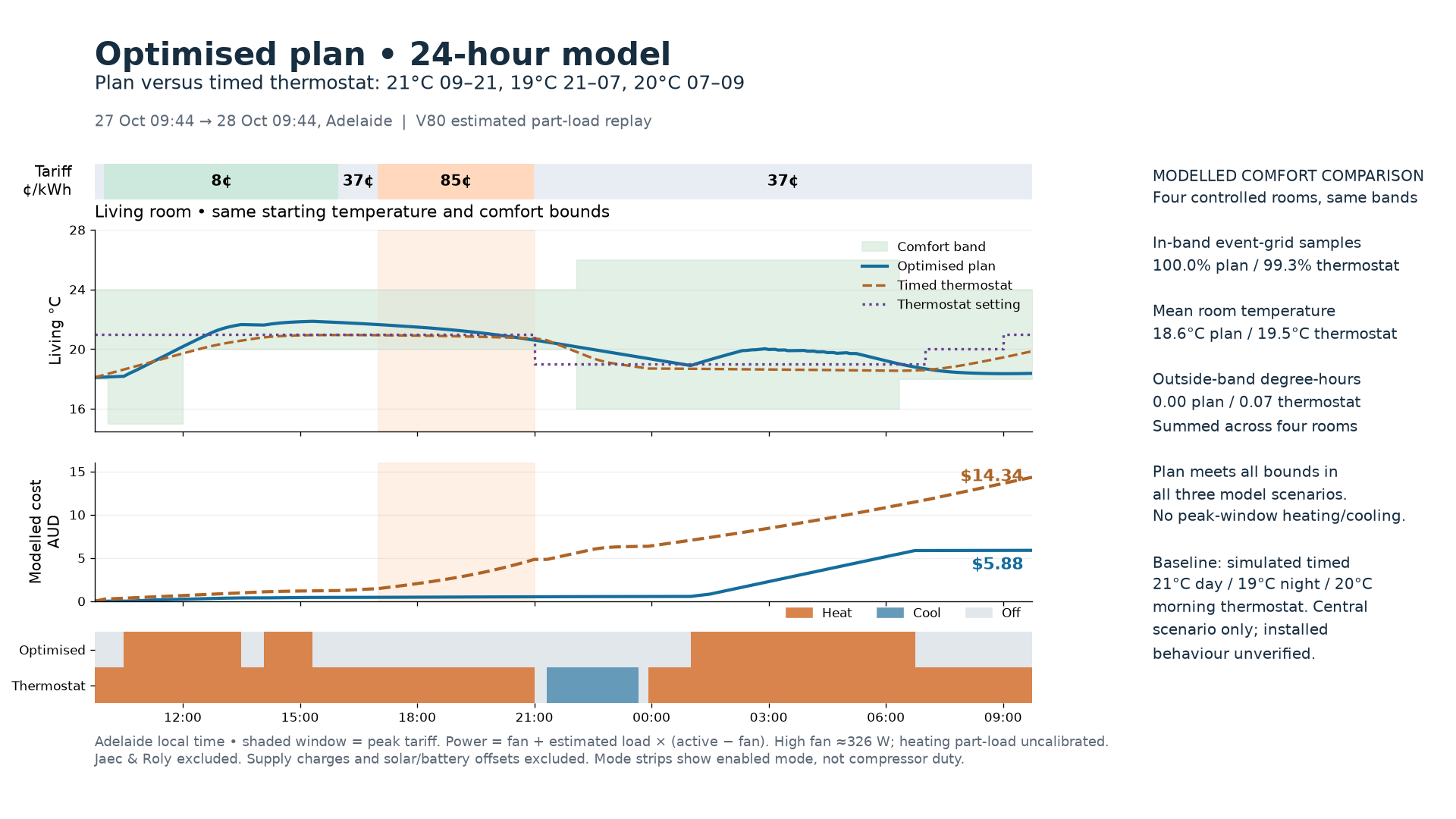
A 24-hour model compares an optimised plan with a simulated timed thermostat for 27–28 October 2026. The plan meets the comfort bounds in all three model scenarios and avoids heating or cooling during the peak tariff window. Modelled costs are $5.88 for the plan and $14.34 for the thermostat; heating part-load remains uncalibrated and installed thermostat behaviour is unverified. These are simulation results, not measured savings.

24-hour model for 27–28 October comparing an optimised plan with a timed thermostat: modelled costs $5.88 and $14.34, with 100% and 99.3% of comfort samples in band respectively. Simulation only; heating part-load is uncalibrated.View planning chart at full size (new tab)

02 / Completed 24-hour monitoring run

Actual operation, including a safeguard stop

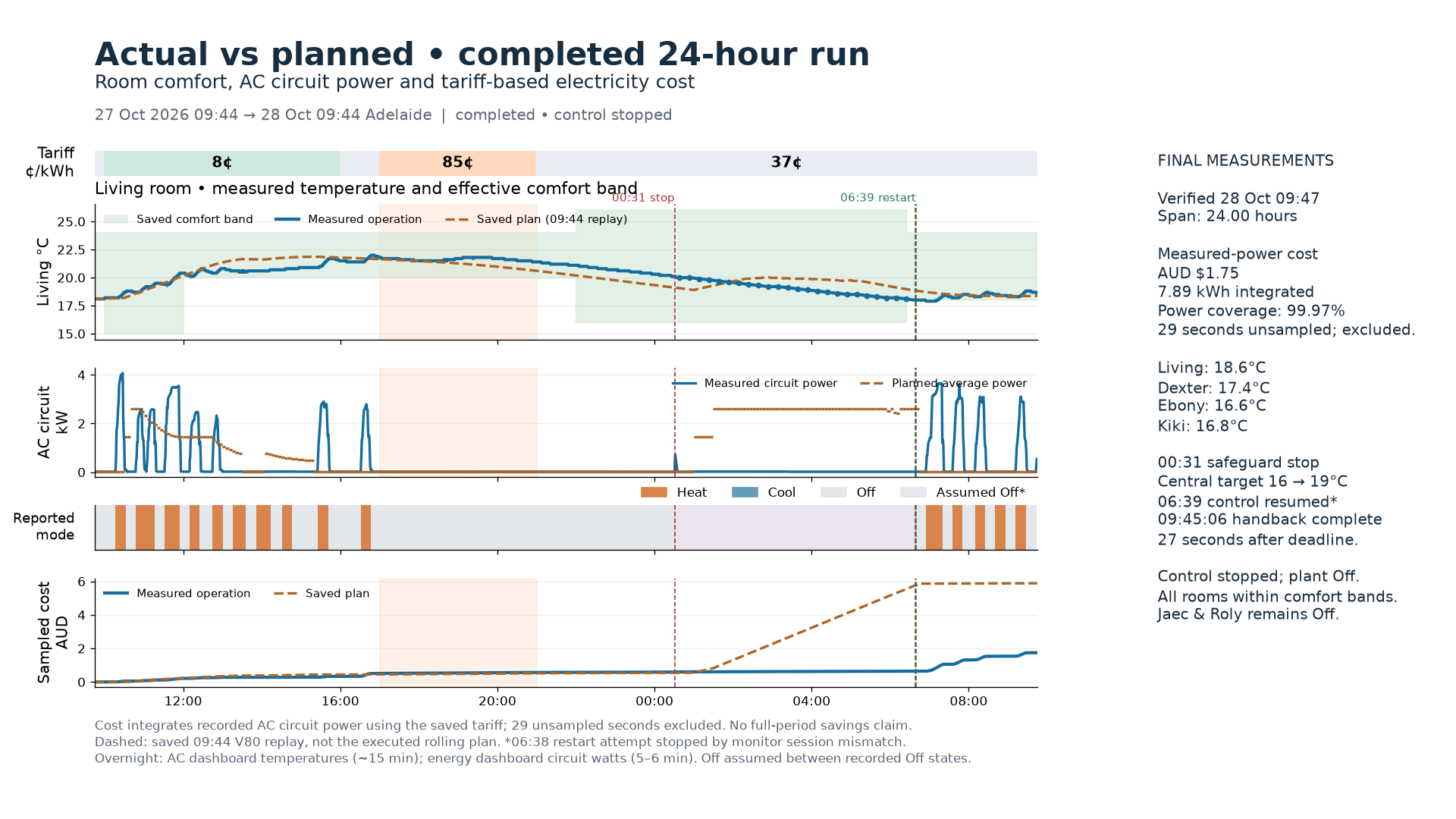
The residential run from 27 October at 09:44 to 28 October 2026 at 09:44 Adelaide time records room temperature, AC circuit power, operating mode and tariff-based cost. Recorded consumption was 7.89 kWh at a cost of $1.75, with 99.97% power coverage; 29 unsampled seconds are excluded. A safeguard stopped control at 00:31, and control resumed at 06:39. All rooms were within their comfort bands at the final check.

The dashed comparison is a saved model replay, not the rolling plan executed during the run. The monitoring period includes an interruption and does not demonstrate uninterrupted control or savings against a thermostat baseline.

Completed 24-hour residential run, 27–28 October 2026: measured room temperature, AC circuit power and $1.75 tariff-based cost for 7.89 kWh. Includes a 00:31 safeguard stop and 06:39 restart. Dashed lines show a saved model replay, not the executed rolling plan.View monitoring chart at full size (new tab)

CONTEXT-AWARE COORDINATION

An optimisation layer for the systems already in place

Fixed schedules follow preset times. Voroven is developing software that uses forecasts and the building's operating context to decide when and how equipment should run, then checks what actually happened.

The innovation lies in coordinating decisions across different systems while respecting the requirements of each environment.

Build on existing controls

Connect through compatible devices, services and building control interfaces. The aim is to add coordinated optimisation without requiring wholesale replacement of existing control systems. Compatibility and integration effort are assessed for each site.

Adapt to each environment

Bring schedules, occupancy, equipment capabilities and operating requirements into a shared model. The same optimisation approach is being extended from residential HVAC to schools and other flexible electrical loads.

Keep people and operating limits in control

Plan around agreed comfort, safety and equipment constraints. Controlled integrations are designed to respect manual overrides, resolve control conflicts and support safe fallback behaviour.

SECTOR RESEARCH

Research and related projects

Published research and deployment projects provide context for building energy optimisation, including the practical challenges of integration, commissioning and measuring outcomes.

Building flexibility and renewable integration

The Australian i-Hub program examined renewable integration with heating and cooling, including Living Labs in occupied buildings. Its final report brings together findings from the program’s research and demonstration projects.

Predictive control in practice

A 2025 Lawrence Berkeley National Laboratory paper presents a commercial-building HVAC model predictive control field demonstration. It also examines the challenge of assessing whether benefits justify implementation costs for a particular building.

Read the Berkeley research

Deployment at commercial sites

Shell Energy’s Smart Energy Hubs project aims to demonstrate whole-site demand flexibility across commercial and industrial sites. It addresses deployment costs and technical, operational and commercial barriers to wider adoption.

Explore Smart Energy Hubs

These independent projects provide sector context; their results are not Voroven performance results.

Voroven

Get in touch

For partnerships, pilot opportunities or general enquiries, contact:

hello@voroven.com